E-Shram Card Registration:- India runs on the labour of people who don’t appear in any official employment records. The mason who built your neighbour’s house. The woman who comes in every morning to cook and clean. The auto driver waiting outside the hospital. The fisherman who’s been out on the water since 3 AM. The delivery partner who shows up at your door in the rain.
These workers – hundreds of millions of them — form the backbone of the Indian economy. And for most of India’s history as an independent nation, they’ve had almost no access to the kind of social protection that formal sector employees receive as a matter of course: no provident fund, no ESI health coverage, no pension, no safety net when things go wrong.
The e-Shram Card is the central government’s most serious attempt yet to bring these workers into a formal system. It won’t fix everything overnight. But it does something foundational — it creates a permanent, verified identity for unorganised workers in a national database, and it opens the door to welfare benefits that were previously out of reach.
If you or someone in your family works in the unorganised sector, this guide covers everything you need to know — what the card actually does, who qualifies, what benefits you can access, and how to register without running into avoidable problems.
Understanding the Unorganised Sector — Why This Matters
Before getting into the details of the scheme, it’s worth understanding the problem it’s trying to solve.
India’s workforce is roughly 90 per cent unorganised. These are workers without formal employment contracts, without employer-contributed provident funds, without ESI health insurance, and without any guaranteed minimum wage enforcement in practice. When they fall sick, they pay out of pocket. When they get injured on a construction site, there’s often no compensation. When they grow old and can no longer work, there’s no pension waiting.
The absence of a central database made this worse. Government welfare schemes existed, but reaching the right workers with the right benefits was nearly impossible without knowing who and where these workers were.
The COVID-19 pandemic made this gap brutally visible. When lockdowns began and work stopped overnight, crores of unorganised workers had no income, no savings, and no way for the government to identify them quickly enough to provide relief. The scenes of migrant workers walking hundreds of kilometres home became a defining image of that crisis — and a direct consequence of this invisibility.
The e-Shram portal was launched in August 2021 partly in response to this — to build the database that should have existed decades ago.
What Is the e-Shram Card?
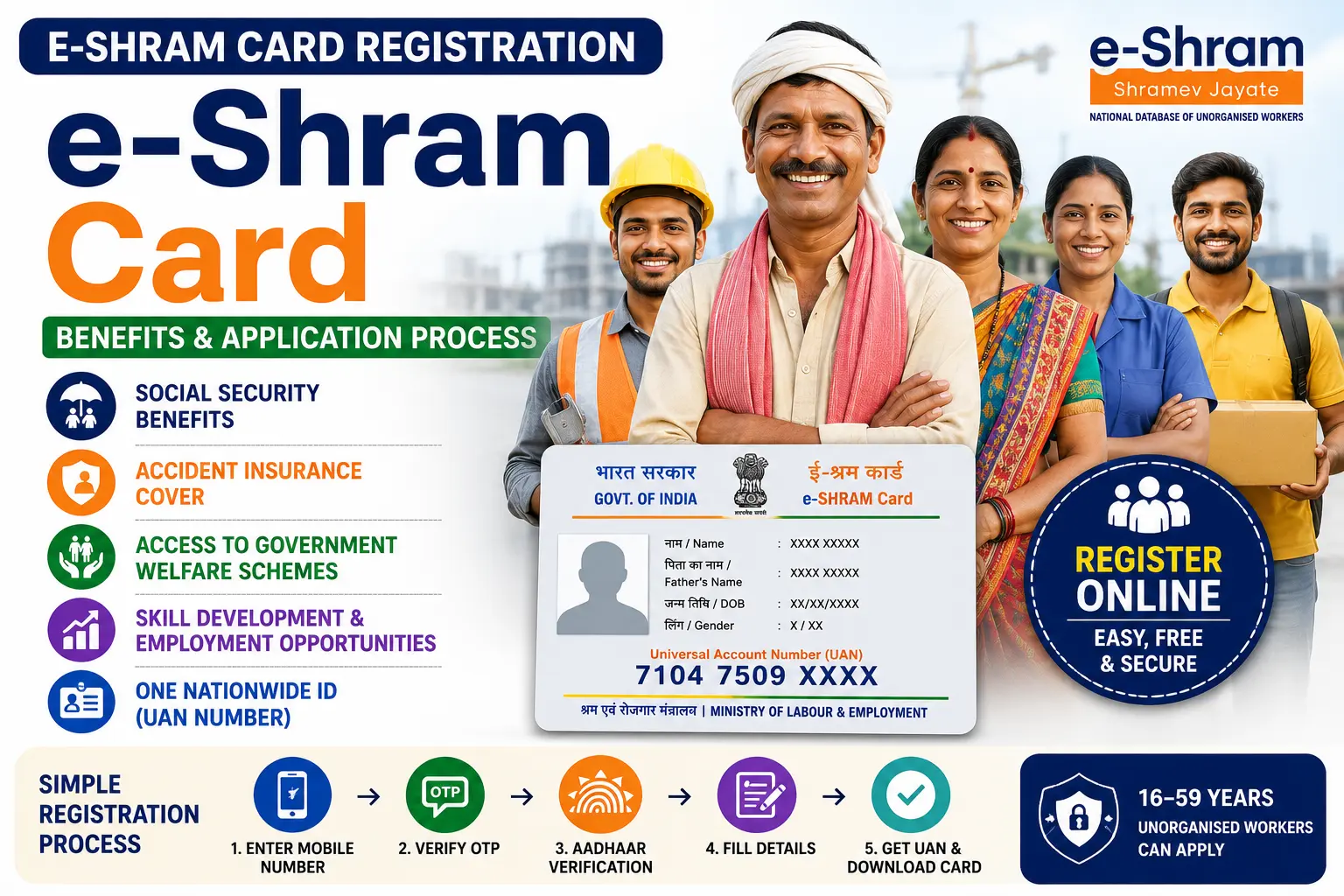
The e-Shram Card is an identity document issued by the Ministry of Labour and Employment to workers in India’s unorganised sector. Every worker who successfully registers receives a 12-digit Universal Account Number (UAN) — a permanent identification number that stays with them for life, regardless of where they work, what job they do, or which state they live in.
That portability is one of the scheme’s most important features. A migrant worker from Kerala working on a construction site in Bengaluru has the same UAN as when they were farming in their home district. A domestic worker who switches employers every few years keeps the same number. It’s one identity, permanently attached to one person, across the entire national system.
The e-Shram portal currently has over 30 crore registered workers across India — making it the largest database of unorganised workers the country has ever built. But with an estimated 38 to 40 crore unorganised workers in total, there’s still a significant gap. Millions of eligible workers haven’t registered yet, often simply because they don’t know about the scheme or assume it doesn’t apply to them.
Who Is Eligible to Register?
The eligibility criteria are deliberately broad, because the scheme is designed to cover as many unorganised workers as possible.
You can register if:
- You are an Indian citizen
- You are between 16 and 59 years of age
- You work in the unorganised sector
- You are not a member of EPFO or ESIC under the applicable eligibility conditions
- You are not an income tax payer
That last two points are the main exclusions. If your employer deducts EPF from your salary, you’re in the formal sector and not the target group for this scheme. If you file income tax returns, you’re also excluded. For everyone else in informal work — the vast majority of working Indians — registration is open.
Which Jobs Qualify?
The list is extensive. Some of the most common eligible occupations include:
Construction and Infrastructure
Masons, labourers, painters, welders, plumbers, electricians, carpenters, tile workers, scaffolding workers, stone cutters, road construction workers
Agriculture and Allied Sectors
Agricultural labourers, farmworkers, irrigation workers, fishermen, fish processing workers, poultry and dairy workers, plantation workers
Domestic and Household Work
Cooks, cleaners, caretakers, drivers employed in households, gardeners, security guards employed informally
Trade and Commerce
Street vendors, small shop workers, hawkers, market labourers, porters and loaders
Transport
Auto rickshaw drivers, taxi drivers, truck drivers, tempo drivers, e-rickshaw operators, cycle rickshaw pullers
Manufacturing and Crafts
Tailors, garment workers, beedi workers, handloom and powerloom workers, leather workers, pottery makers, blacksmiths, weavers
Platform and Gig Work
Delivery partners (Swiggy, Zomato, Amazon, Flipkart), ride-hailing drivers (Ola, Uber, Rapido), freelance workers on digital platforms
Other Categories
Migrant workers, waste collectors, rag pickers, sanitation workers employed informally, barbers, washermen, cobblers, salt workers, forest produce collectors
If your work is informal — no employment contract, no EPF deductions, no ESI coverage — you almost certainly qualify.
What Benefits Does the e-Shram Card Give You?
This is the question that matters most, and it deserves a thorough, honest answer.
The e-Shram Card is primarily a registration and identification tool. It creates your place in the national database. The benefits you can access depend on which government welfare schemes are linked to that database — and that list is growing over time.
Here’s a detailed breakdown of what’s currently available and what’s on the horizon:
1. Accident Insurance Under PMSBY
This is the most immediate and concrete benefit of e-Shram registration.
Registered workers are covered under the Pradhan Mantri Suraksha Bima Yojana (PMSBY), which provides:
- ₹2 lakh in case of accidental death or permanent total disability
- ₹1 lakh in case of permanent partial disability
For a construction worker climbing scaffolding every day, or a fisherman going out to sea before dawn, or a truck driver covering hundreds of kilometres on Indian highways — this cover is genuinely meaningful. And through e-Shram registration, accessing it costs nothing.
It’s worth noting that the insurance coverage conditions and renewal timelines have been updated periodically since the scheme launched. Always check the current status on the official portal.
2. Access to Government Welfare Schemes
The e-Shram database is actively used by both central and state governments to identify and reach eligible workers for welfare programmes. Registered workers have been included in schemes covering:
- Food security and ration benefits
- Housing assistance (including PMAY linkages)
- Skill development and training programmes
- Financial assistance during crises
- Health and maternity benefits under various state schemes
Kerala specifically runs several state welfare schemes for which e-Shram registration can serve as identity verification. Workers registered on the portal are easier to identify and enrol in these programmes.
3. Priority Identification in Emergencies
The COVID-19 experience showed what happens when there’s no database — relief can’t reach the people who need it most. The e-Shram registration ensures that in future crises, registered workers are identifiable, locatable, and reachable for emergency support.
This is a benefit that’s hard to quantify in advance but potentially enormous in impact when it matters.
4. Skill Development and Employment Linkages
Registered workers gain access to skill development programmes and training opportunities linked through government platforms. The National Career Service (NCS) portal and various state employment exchanges are increasingly integrated with the e-Shram database, connecting registered workers with employment opportunities and upskilling programmes.
5. Foundation for Future Benefits
This is perhaps the most important long-term value of registering now. Policy direction is clearly moving toward linking more social security benefits directly to the e-Shram database. Workers who are already registered when new schemes roll out will have immediate access. Those who haven’t registered will need to do so at the last minute, often in a rush and sometimes missing out entirely.
Registering today is essentially an investment in your access to future benefits.
Complete Benefits Overview
| Benefit | What You Get | When It Applies |
|---|---|---|
| Universal Account Number | Permanent 12-digit worker ID | Immediately after registration |
| Accident Insurance (PMSBY) | ₹2 lakh death/total disability, ₹1 lakh partial disability | During covered period |
| Welfare Scheme Access | Central and state programme eligibility | Ongoing, as schemes are linked |
| Emergency Relief Priority | Faster identification during crises | During declared emergencies |
| Skill Development | Government training programme access | Ongoing |
| Employment Linkages | NCS portal and state exchange connections | Ongoing |
| Future Benefits | New schemes as they’re linked to database | As government policy evolves |
Documents You Need Before Registering
The good news is that the document requirements are minimal compared to most government registrations. You need:
- Aadhaar Card — the primary identity document; mandatory
- Aadhaar-linked mobile number — OTP verification goes here; must be active
- Bank account details — account number and IFSC code for benefit disbursements
- Occupation information — what kind of work you do
- Address details — current residential address
The Most Important Check: Is Your Mobile Number Linked to Aadhaar?
This is where most registration failures happen. The entire OTP-based verification process depends on your mobile number being linked to your Aadhaar. If it’s not linked, you cannot complete registration online.
How to check: Go to the UIDAI website (uidai.gov.in) and use the “Verify Aadhaar” or “Check Aadhaar Mobile Linking” option. Alternatively, send an SMS from your mobile number to UIDAI’s helpline number to check.
If your number isn’t linked: Visit your nearest Aadhaar enrolment centre or Common Service Centre (CSC) with your Aadhaar and mobile number. The linking process is straightforward and usually done on the same day. Once linked, come back to e-Shram registration.
How to Register for an e-Shram Card — Complete Step-by-Step Process
Step 1: Go to the Official Portal
Open eshram.gov.in in your browser. Be careful to use the official government URL. There are third-party websites that mimic the portal’s appearance and sometimes charge fees for “assisted registration” — the official process is free and needs no middleman.
Step 2: Select “Register on e-Shram”
The registration button is prominently placed on the homepage. Click it to begin the process.
Step 3: Enter Your Aadhaar-Linked Mobile Number
Type in the mobile number registered with your Aadhaar. The page will also ask whether you’re currently a member of EPFO or ESIC. Answer this accurately — it determines your eligibility. If you’re not sure, the answer for most informal workers is no.
Step 4: OTP Verification
An OTP is sent immediately to your registered number. Enter it on the screen to proceed. The OTP typically expires in a few minutes, so have your phone ready before you click the send button.
If the OTP doesn’t arrive:
- Check that your phone has network signal
- Confirm the mobile number you entered matches your registered Aadhaar number
- Wait two to three minutes — there’s sometimes a delay
- Request a fresh OTP if the first one expires
Step 5: Aadhaar Number Entry and Verification
Enter your 12-digit Aadhaar number. The system connects to the UIDAI database and pulls your basic information automatically — name, date of birth, gender, and address as registered with UIDAI.
Review this information carefully when it appears. If something is wrong — a misspelled name, incorrect date of birth — it means your Aadhaar record has an error, and you’d need to correct that through UIDAI before proceeding.
Step 6: Complete the Remaining Profile
The fields that don’t auto-populate from Aadhaar need to be filled in manually:
Current Address
If you’re living somewhere different from your Aadhaar address — which is common for migrant workers — enter your current address here. This is the address that will be used for correspondence and some benefit verifications.
Occupation Details
Select the category that best describes your work. If your specific occupation isn’t listed, choose the closest matching category. Be accurate here — occupation data is used to direct relevant scheme information to you.
Educational Qualification
Select your highest level of education. This information is used for skill development programme matching.
Skill Details
Enter skills you have — even informal ones count. This data connects you to relevant training and employment opportunities through the NCS portal.
Bank Account Information
Enter your account number and IFSC code carefully. This is where any cash benefits or disbursements will be sent. A wrong digit in your account number means benefits can’t reach you — so double-check against your passbook or bank statement.
Step 7: Final Review and Submission
Go through every field before submitting. Check:
- Name matches your Aadhaar exactly
- Bank account number and IFSC are correct
- Current address is accurate
- Occupation category is appropriate
Once you’re confident everything is right, submit the application.
Step 8: Download Your e-Shram Card
Your UAN is generated immediately after successful submission. You don’t have to wait — download your e-Shram Card as a PDF right away.
Save it in multiple places: on your phone, in your email, and print a physical copy. The card is accepted as valid identity proof for unorganised workers across India.
How to Download Your e-Shram Card Later
Already registered but need to re-download your card?
- Visit eshram.gov.in
- Click on “Already Registered” or the login option
- Enter your registered mobile number
- Verify with OTP
- Navigate to your profile or UAN card section
- Download the PDF
The card is available for download anytime — there’s no limit on how many times you can retrieve it.
Keeping Your e-Shram Profile Updated
Registration is the first step, not the last. Your e-Shram profile is only useful if the information in it is current. Here’s what to update and when:
Mobile Number
If you change your phone number, update it immediately. All OTP communications and scheme notifications go to your registered number. An outdated number means you could miss critical information.
Address
Especially important for migrant workers. If you move to a different state or city for work, update your address on the portal. Some state-level benefits are linked to current residential address.
Bank Account
If you change banks or open a new account, update this right away. Any benefit disbursements go to the account on file — if it’s closed or wrong, the money goes nowhere.
Occupation
If your work changes significantly — for example, you move from agricultural labour to construction, or start working as a delivery partner — update your occupation category. This affects which scheme notifications and opportunities you receive.
Updating is straightforward: log into the portal with your registered mobile number, verify with OTP, go to your profile, and make the changes.
Why Registration Fails — Complete Troubleshooting Guide
Problem: Mobile number not linked to Aadhaar
This is the single most common registration failure. Without an Aadhaar-linked mobile number, OTP verification cannot happen.
Solution: Visit an Aadhaar enrolment centre or CSC with your Aadhaar card and mobile number. Get the number linked first, then return to register on e-Shram.
Problem: OTP not received
Several things can cause this — poor network, wrong number entered, number not active.
Solution: Check network coverage, confirm the number matches your Aadhaar registration, wait a few minutes, request a fresh OTP.
Problem: Aadhaar verification fails
Usually caused by entering the wrong Aadhaar number or a mismatch in the UIDAI database.
Solution: Double-check your Aadhaar number against the physical card. If the UIDAI record itself has errors, contact UIDAI to correct them.
Problem: Bank account details rejected
Account number or IFSC entered incorrectly.
Solution: Check your passbook or ask your bank for the correct details. Re-enter carefully.
Problem: Registration page freezes or session expires
Can happen with slow internet connections, particularly on mobile data.
Solution: Use a stable WiFi connection if possible. If the session expires, start again from the beginning — your previous incomplete attempt shouldn’t cause any issues.
Problem: Already registered but no card
Sometimes the registration goes through but the card download doesn’t complete.
Solution: Log back in with your mobile number, verify with OTP, and try downloading again from your profile page.
Frequently Asked Questions
Is e-Shram registration completely free?
Yes, completely free through the official portal. There is absolutely no charge for registering. If anyone — an agent, a CSC operator, a local “helper” — is asking you to pay money to register on e-Shram, they are either running a scam or overcharging for a service that should cost nothing. Report them if possible and register directly on the official portal yourself.
Can I register from my smartphone at home?
Yes. The entire process works on a smartphone browser. You don’t need a computer, you don’t need to visit any office, and you don’t need anyone’s help — though if you’re not comfortable doing it yourself, a trusted CSC centre can assist for free.
What is the UAN and is it different from Aadhaar?
Yes, they’re different. Your Aadhaar is your general identity number across all government systems. Your UAN (Universal Account Number) from e-Shram is specifically your worker identity in the national unorganised labour database. Both are 12 digits, but they serve different purposes and have different numbers.
I’m a gig worker on Swiggy or Zomato. Am I eligible?
Yes. Platform and gig workers are explicitly included in the eligible categories, provided you’re not covered under EPFO and not an income tax payer. The government recognizes gig work as part of the unorganised sector and e-Shram registration is open to you.
I work in Kerala but I’m originally from another state. Can I still register?
Yes. Migrant workers are one of the primary target groups for this scheme. You register with your current address and your Aadhaar details, regardless of your home state. The UAN is valid nationally.
My Aadhaar still shows my old village address. Can I register?
Yes. During e-Shram registration, you can enter your current address separately. Aadhaar is used for identity verification, not as your mandatory current address. Enter where you actually live now in the address field.
Can women domestic workers register?
Absolutely. Domestic workers — cooks, cleaners, caretakers — are one of the core target groups for the scheme. Women domestic workers are strongly encouraged to register. The scheme recognizes domestic work as labour and the workers performing it as deserving of social protection.
What happens if I become a formal sector employee later?
If you join a job where EPF is deducted from your salary, you technically no longer meet the e-Shram eligibility criteria. In practice, you would update your employment status on the portal. Your UAN record would remain, but benefit eligibility would change based on your new employment status.
Can senior citizens above 59 register?
The current age limit for new registration is 59. Workers who registered before turning 60 may continue to hold their membership and access applicable benefits. New registrations above 59 are generally not permitted under the current rules.
Is the e-Shram Card valid as general ID proof?
Yes. The e-Shram Card with your UAN is accepted as a valid identity proof for unorganised workers across India. It’s particularly useful in situations where you need to prove your worker status and identity.
The Honest Assessment: Is It Worth Registering?
Let’s be direct about this.
The e-Shram Card is not going to immediately transform your financial situation. It’s not a monthly payment. It’s not a guaranteed pension (though pension schemes may be linked in future). It’s primarily an identity and database tool.
But here’s why it’s still genuinely worth doing — even today:
The accident insurance is real and immediate. For workers in physically dangerous occupations — construction, fishing, driving, agriculture — a ₹2 lakh accidental death or disability cover is meaningful. It costs nothing through e-Shram registration. If you work in a dangerous job and you haven’t registered, you’re leaving free insurance on the table.
Being in the database matters more than it seems. Every welfare scheme that gets linked to e-Shram going forward benefits registered workers first and most easily. The government is clearly moving in the direction of using this database as the primary channel for reaching unorganised workers. Getting into it now is much better than scrambling later.
It takes 15 minutes and costs nothing. Unlike most government registrations that require office visits, long queues, and multiple document submissions, e-Shram registration can be done entirely on a smartphone at home. The effort-to-benefit ratio is hard to argue with.
For Kerala specifically: A large portion of Kerala’s workforce is in the unorganised sector — construction workers, agricultural labourers, domestic workers, fishermen, small traders, and the millions of migrant workers who’ve come to Kerala from other states. Every one of them is eligible. Every one of them can register from their phone. Very few of them have done so yet.
Bottom Line
The e-Shram Card is the government finally acknowledging what was always true: that India’s unorganised workers deserve to exist in an official system, and that social protection shouldn’t be reserved only for those lucky enough to have a formal employer.
Registration is free. It takes 15 minutes. It requires no office visit. It gives you a permanent worker identity, immediate accident insurance coverage, and access to a growing set of welfare benefits.
If you’re in the unorganised sector and you haven’t registered yet, do it today. And if you know someone — a construction worker, a domestic helper, a street vendor, a fisherman, a delivery partner — who hasn’t registered, help them do it. The process is simple enough that you can walk someone through it in less than half an hour.
Register on the official portal at eshram.gov.in, keep your details updated, and stay informed about new schemes as they’re linked to the database.
Stay connected with SpotNews Kerala for more guides on government schemes, online services, certificates, pensions, jobs, and public welfare programmes.